


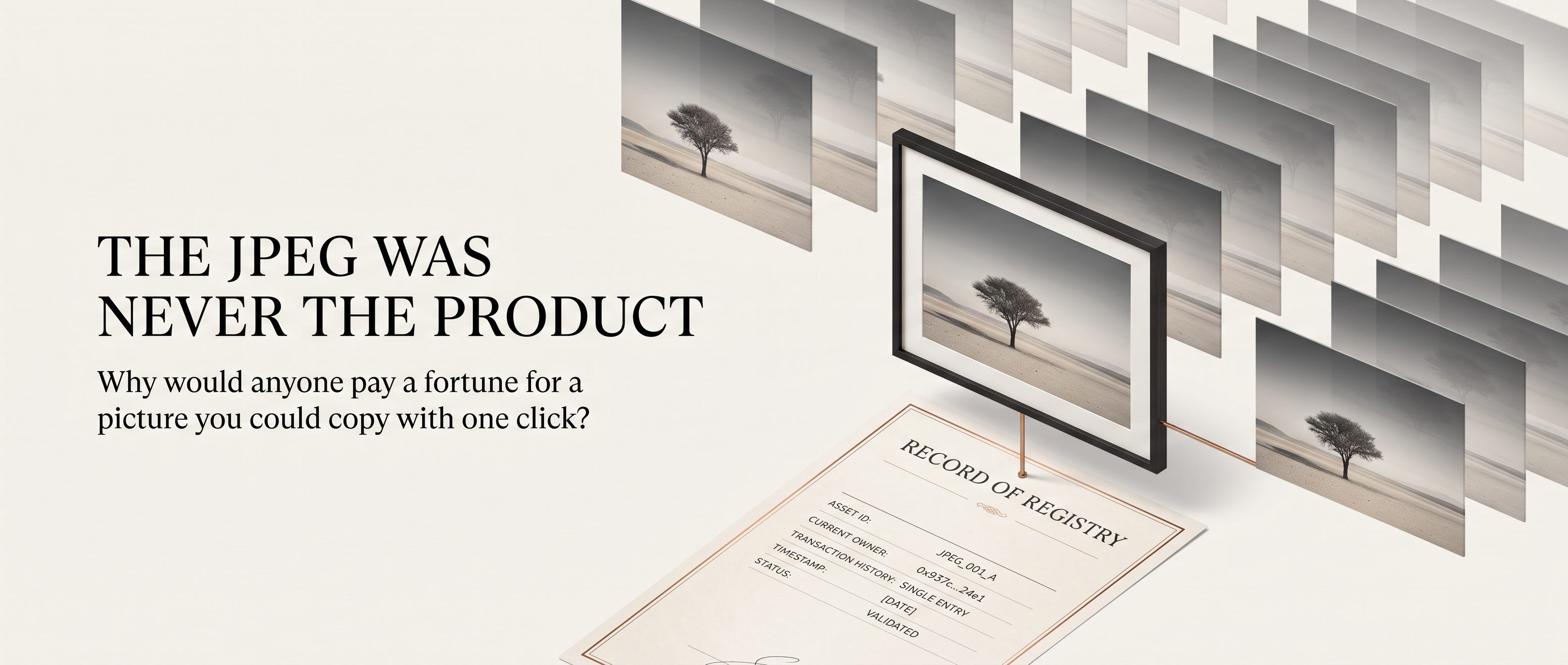
Why would anyone pay a fortune for a picture you could copy with one click?
On some level, this objection is insurmountable. Now the same file sits on my drive, an identical pixel for pixel replica to yours. The difference is I paid nothing for it.
The thing is this objection misses the entire point that NFTs were never about the picture. The picture was always free to copy but the record beneath it was what transferred. Hence, when someone bought a cartoon ape, what was exchanged was not exclusive possession of the image since the image was already available to the entire internet.
So what does buying an NFT even mean? A great example would be buying a home, only instead of the physical structure, you bought the deed. Anyone can photograph a house, print or frame the image, sell it, or post it online. None of those copies grants ownership of the house. The photograph is reproducible, but the deed is unique and the only identifier of who holds the claim.
Hence, an NFT was a public, transferable record of token ownership, sort of like a deed in the narrowest sense, and only for the token itself. It did not automatically convey copyright, confer control over the artwork, or turn a JPEG into legally enforceable property.
That is an import distinction, especially the fact that the record could exist at all. Digital files are infinitely reproducible, so your copy and mine can contain the same bits in the same order, with no meaningful “original” in the ordinary sense. That makes proving digital ownership difficult, because ownership depends on scarcity while the internet is designed for replication.
That is why the picture itself is not the invention. The invention is the record which makes one digital claim provably scarce, publicly inspectable, and transferable without asking one company to keep the master database.
Ironically, the record was the least photogenic object in the room. A public, provable, scarce claim to a recognizable thing naturally becomes a status object. The signet ring. The roped-off table. The numbered edition. The watch worn less for the time than for the wearing. People have always paid for visible scarcity.
When technology made that scarcity possible for digital objects, its first mass-market use was not a song title or a warehouse, but for status. Status was the flex. The profile picture. The floor price. The private Discord. The ape as a badge. This is how the invention became obscured. Instead of the NFT boom being a price casino, it was a status casino.
Buyers wagered on resale value and also on prestige, with prestige being one of the oldest things people gamble on. Unlike a pure price bubble, a status game rotates. Yesterday’s coveted badge becomes tomorrow’s embarrassment, and the crowd migrates to the next symbol. Yet this surface-level churn does not tell us if there was a record underneath.
All this being stated, the NFT market was ridiculous. The balance between speculation and utility was lopsided beyond reason. People traded cartoons, obsessed over floor prices, and treated profile pictures as membership cards for a new aristocracy. Durable uses remained limited, specialized, and unglamorous. And worse, the record often recorded almost nothing.
Owning a token linked to an image usually conveyed no copyright, no control over copying, and no automatic legal interest in the underlying work. Sometimes the token pointed to artwork through a link that could fail. Sometimes the mint was unauthorized. Sometimes the “asset” amounted to little more than vanity and vapor. These are fair critiques, but they do not reach the invention.
The reason things went wrong is that people mistook a record in and of itself to have some value. However, make no mistake that a clean title record to something worthless is still a clean title record to something worthless. A weak payload did not erase the record. The chain could show who held the token, when it moved, and the sequence of transfers. It made the claim public and inspectable. Yet, it could not make the underlying claim valuable, authorized, or enforceable.
NFTs can preserve a record but it cannot make the record matter. Attach nothing, and the NFT represents nothing meaningful. Attach a broken link, and the token points to a ghost. Attach no rights, and the holder owns only the token. Attach a real entitlement, like a ticket that opens a door, a license that grants use, a credential a verifier accepts, or a claim backed by law, and now the NFT becomes useful. Currently, those uses are early, narrow, and mostly unglamorous. The mistake is thinking every digital claim is worth owning.
So let us return to the picture I can copy with one click. Copy it once or copy it a thousand times, each copy a perfect replica, yet worthless as a claim since the claim was never in the pixels. The fact that most people tied the record to vanity, vapor, status, and floor price, or sold trophies as property, or dare I say turned a serious invention into a public spectacle deserving to be mocked, does not prove the validity or invalidity of the invention.
The crowd came for the trophy and mistook it for the deed. The trophy was the JPEG, the flex, and the floor price. The deed is the boring, more difficult concept to grasp: a digital claim that could be scarce, transferable, and publicly inspectable.
Most NFTs made the claim ridiculous, but they did not make the invention disappear.