


The promise of “AI abundance” is usually that AI has an energy problem today, but in time, as the cost per token plummets and the performance per watt keeps rising, today’s concerns may be outdated within two hardware cycles. In truth, inference costs have fallen dramatically, while AI hardware has continued to improve in both price-performance and energy efficiency. Unfortunately, the people making this argument are right about the costs improving, but wrong about the result.
An operator does not get invoiced in joules per token. He gets invoiced in megawatt-hours by the utility company which is a physical plant with a fixed capacity. If consumption per unit of work is reduced by a factor of ten while the work grows by a factor of a hundred, then the meter still turns ten times faster than it did before. Hence, efficiency can produce real savings and still raise the total. That is not a flaw. Good engineering is supposed to make more use possible.
That pattern has a name. In 1865, an English economist named William Stanley Jevons noticed that as steam engines got better at burning coal, Britain burned more coal rather than less. Efficiency made coal cheaper to use, cheaper use widened the range of things worth doing with it, and the wider range consumed more than the savings returned. Jevons was not theorizing but instead counting tons of fuel in billing. That became known as the Jevons paradox.
Jevons describes a tendency, not a law, that cheaper use tends to invite more use. The rebound from an efficiency gain is often partial, real savings do survive it, and economists have debated about the size of the effect for more than century. For my purposes, the fundamental point is thermodynamic: whatever total level of use ultimately emerges must still be paid for in joules.
I know this from the other side. In 2006, I began developing waterless modular thermal-conditioning systems. Part of the early inspiration came from my fascination with Google’s distributed search architecture and the broader possibilities of parallel design. Depending on the model, these systems use up to eighty percent less electricity than the conventional designs they replaced and typically reach operating temperature two to three times faster. That equipment, together with the models I have developed since, now operates across more than forty industries around the world. The intellectual spark came from computing, but the savings came from physical engineering. Software controls the equipment and they were the last thing I programed. Software does not create the underlying efficiency.
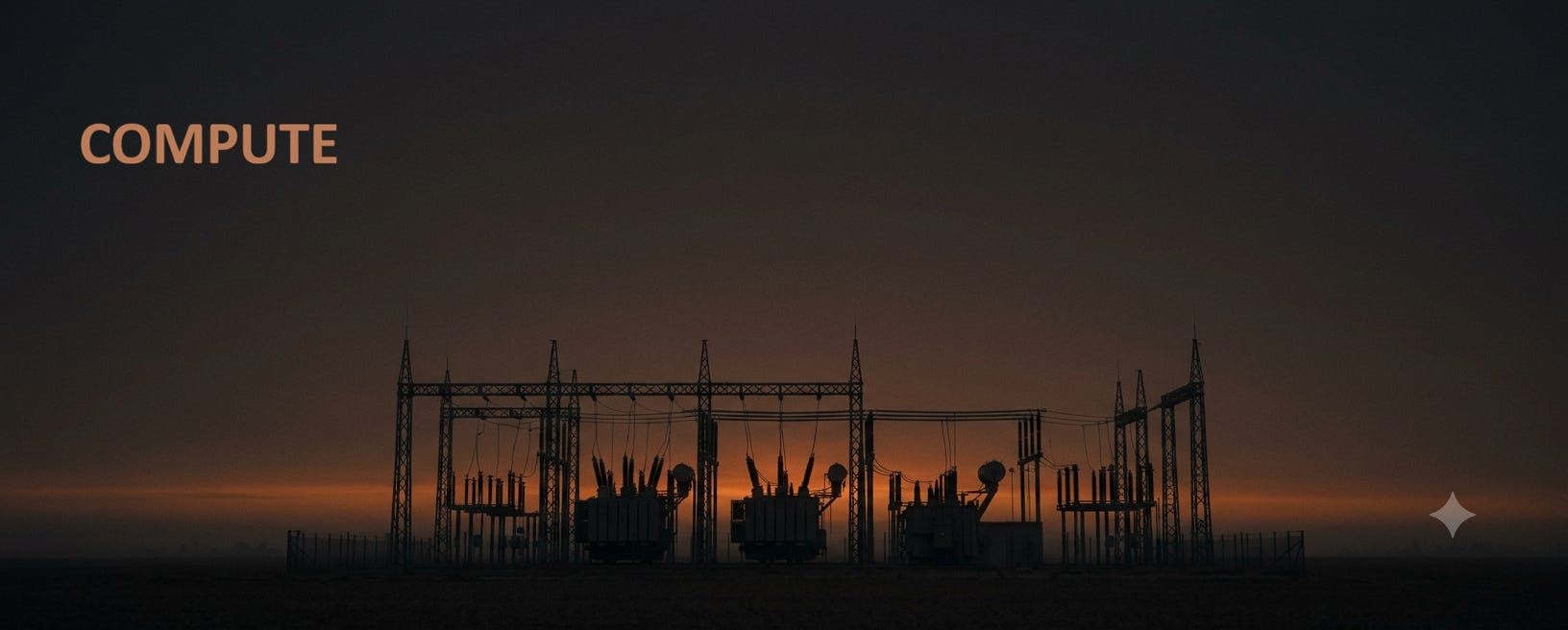
The AI buildout underway now settles the same kind of bill. A model can be distilled in a week. A substation cannot. Berkeley Lab reports that, for generation and storage projects completed in 2025, the median time from interconnection request to commercial operation exceeded five years. Large transformers for substations and generators now carry lead times of roughly three to four years. Where a campus relies on water-intensive cooling, that water comes from a watershed and local system with other claims already upon it. A better model or training run can reduce the physical requirement per task. It cannot shorten the time required to manufacture a transformer, permits and approvals for a transmission line, build a turbine, or pour concrete.
The efficiency argument is strong in that cost per unit of inference has fallen rapidly. Hardware gains are real and compounding. Models can become smaller, better optimized, and less expensive to operate. New generation does get built when there is sufficient money and demand to build it. The forecasts that alarm people are extrapolations, and extrapolated demand curves have an unimpressive record.
My point is narrower than a forecast. You can change how many joules a task requires, but you cannot change that it requires joules, that those joules must be generated somewhere, moved over equipment somebody has to manufacture, and ultimately rejected as heat into air, water, or space.
Orbit is the strongest version of the escape. In January 2026, SpaceX filed with the FCC for authority to operate an orbital data-center system of up to one million satellites. In June, it showed a draft design for AI1: a rack of compute paired with large solar arrays, double-sided radiators, and laser links. Read what that concedes. Nobody proposes manufacturing and launching a constellation on that scale because terrestrial deployment presents no constraint. Orbit simply changes the constraint into launch mass, radiator area, link capacity, radiation exposure, replacement cadence, and finite equipment life. The most ambitious plan to get out from under terrestrial power and cooling is itself one of the largest physical construction projects ever proposed. The constraint did not disappear. It changed address.
Every abstraction in the AI industry eventually asks something physical to make it true. You can write code that needs fewer joules, but you cannot write code that is one.