


People often confuse a technology’s most visible use with its essential purpose, sort of like mistaking the exhaust for the engine. Smart contracts may automate a meaningful share of the work lawyers are paid to perform, even though they have also made fraud cheaper. Anyone can launch a token, make extravagant promises, collect deposits, and disappear. That pattern has repeated so often that the technology has become inseparable from the scam in the public mind. The frauds, rug pulls, and abandoned tokens are real, but they do not determine whether the underlying invention has value.
The pattern predates blockchain. Whenever a technology sharply lowers the cost of creation or distribution, low-quality and deceptive uses often spread faster than institutions can learn to filter them. Gutenberg’s press printed thousands of indulgences for the Church before it printed books. Cheap printing reduced the cost of distributing truth, but it also reduced the cost of propaganda, forgery, and libel.
Photography eventually became a trusted source of factual evidence, yet it was used to deceive almost immediately. By the 1860s, William Mumler was selling photographs that appeared to show deceased relatives beside grieving family members; he was later tried for fraud.
Email transformed the advance-fee scam in much the same way. A scheme that once required paper, postage, and patience could suddenly reach millions of strangers at almost no cost. Email did not invent the scam; it made an old scam cheap to distribute.
Why does fraud so often arrive first? A serious builder needs more than the new tool. The builder also needs customers, trust, standards, reputation, distribution, and often institutions that make the product safe enough for ordinary people to use.
A fraudster needs only the tool and a willingness to deceive. When creation becomes cheap, fraudsters can reach the market faster than people building anything durable. Legitimate applications may remain invisible for years while fraud fills the gap with promises.
What Smart Contracts Make Possible
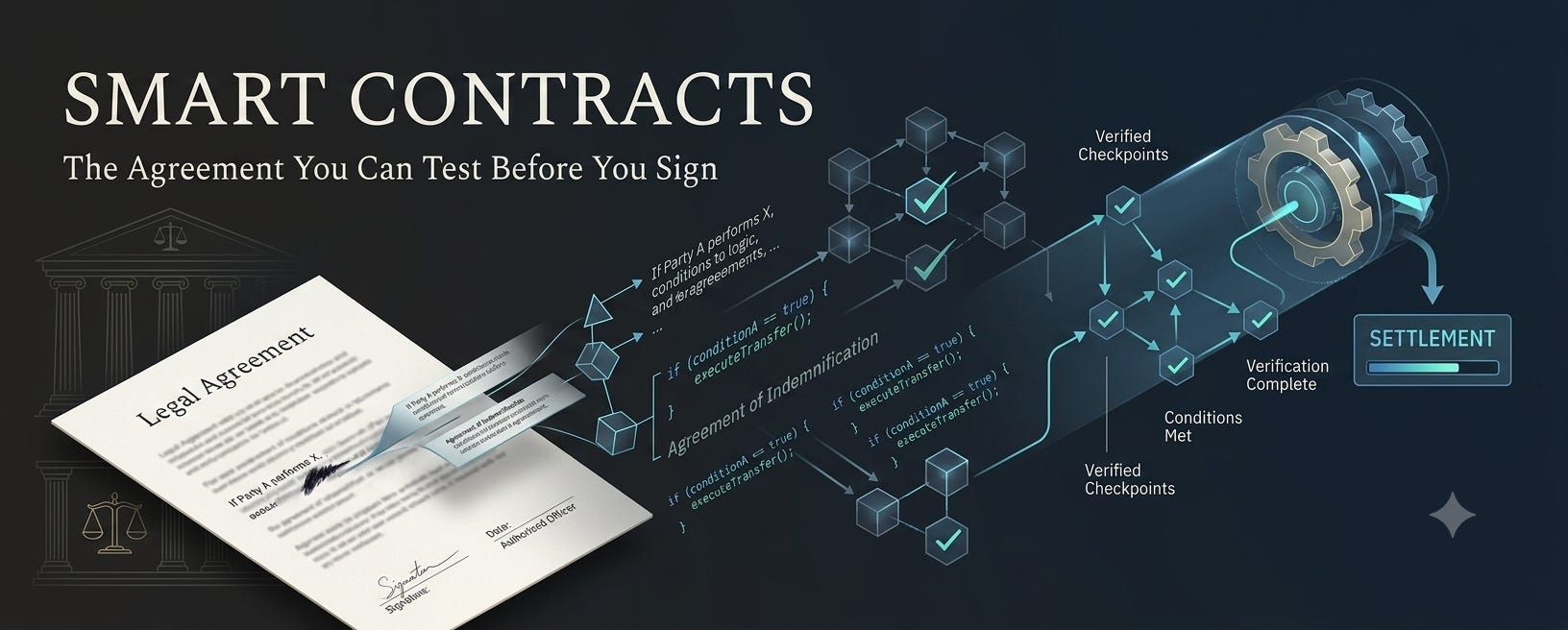
What, then, did smart contracts make so inexpensive that fraud proliferated? In 1994, Nick Szabo described a smart contract as a computerized transaction protocol that executes an agreement’s terms. Blockchain later supplied shared infrastructure for that code. A smart contract can hold assets, apply predefined rules, and transfer value when specified conditions are met, without requiring one institution to control the ledger or manually perform each step.
The deeper innovation is that financial and transactional systems can operate on shared infrastructure rather than remain confined to an institution’s private records. Unlike a traditional written agreement, a smart contract can be tested when it is created. A conventional contract may identify the parties and property, set the price, and still leave crucial questions about performance unanswered:
· Which party must perform first?
· What happens if the goods arrive but payment does not?
· What happens if one condition is satisfied but another is not?
· What happens if performance is late but accepted?
· What happens if the deadline passes while funds remain in escrow?
A lawyer can identify and draft around these gaps, but a written contract cannot be executed as a system. Its operational defects may remain hidden until the parties reach the missing step, often after a dispute has already begun over what the agreement should have required.
Smart contracts differ because their operational logic can be tested before anyone relies on it. Developers can simulate transactions, verify expected outcomes, introduce abnormal inputs, and examine edge cases. In some circumstances, formal verification can show that the code satisfies defined properties for every execution covered by a mathematical specification.
For a conventional contract, the first meaningful test may come only after a breach. For a smart contract, much of the performance machinery can be tested before assent, forcing operational ambiguity to surface as a design problem before it becomes litigation.
Formal verification, however, proves only that the machine follows the map. It cannot prove that the parties drew the right map, that the programmer understood the agreement correctly, or that flawless execution will produce the result the parties intended.
A smart contract also needs access to external facts. Otherwise, it cannot know whether a package arrived, food remained cold, or a machine completed its work. The mechanism that supplies outside data is commonly called an oracle. Oracles deliver that information to smart contracts and can trigger on-chain or off-chain actions in response.
Imagine a sidewalk robot delivering groceries to your home. The store is not paid merely because the robot reaches your address. Payment depends on defined conditions: the compartment must remain sealed, refrigerated items must stay below a stated temperature, and you must confirm that the order is complete. The robot records its location. Sensors track the compartment temperature and whether the seal was broken. You open the compartment, inspect the order, and confirm acceptance.
Those facts are sent to the smart contract. If every condition is satisfied, payment is released. If the temperature exceeded the limit, the seal was broken, or you report a missing item, the funds remain locked and the transaction moves into a refund or dispute process. No employee must reconcile the delivery log with the payment record, and no one must decide whether to charge the card after acceptance. The rules connect a verified event directly to settlement.
The smart contract is not the robot, the sensor, or the food. It is the machinery that connects what happened to what happens next. That distinction matters because outside information can still be wrong: a defective sensor may report a false temperature, a customer may make a false claim, or an oracle may be compromised. The contract makes execution certain only after it accepts the input, but it does not make the input true. Smart contracts therefore do not eliminate trust from physical transactions, but simply narrow where trust is required and make that point easier to identify.
Automation and the Limits of Code
Smart contracts also affect the legal profession. Much legal work happens outside the courtroom and focuses on closing the gap between promise and performance. Even after two parties agree, legal and administrative systems must often verify performance, maintain records, and secure payment.
Many familiar roles address this same problem. Escrow agents hold funds because neither side wants to act first. Transfer agents maintain ownership records. Clearing intermediaries bridge the interval between a trade and settlement. Auditors compare royalty reports with actual sales. Lawyers pursue judgments because winning a case does not itself produce payment.
Escrow makes the problem especially clear. The parties usually agree on what to exchange; the difficulty is sequence. Neither wants to act first, so a trusted third party holds the value until both sides perform. A smart contract can instead hold and release that value when the stated conditions are met. For the portions of a transaction that can be automated, administration no longer needs to be a separate step.
Collection illustrates the same principle. A judgment creates a legal entitlement, but converting that entitlement into payment may cost more than the underlying dispute. Those enforcement costs are why many valid claims are never pursued. If funds are already held under the agreement and settlement occurs automatically after performance, collection disappears from that transaction.
Reconciliation may disappear as well. Much of commerce depends on two parties maintaining separate records and later paying people to make those records agree. A shared record can eliminate much of that work. Royalty accounting follows the same logic: licensors often rely on licensees to report sales accurately, which is why license agreements include audit rights. When royalties are calculated and divided at the moment of sale, settlement becomes immediate.
None of this eliminates law. It does, however, eliminate some of the legal and administrative work created by the gap between promise and performance. Smart contracts automate performance, not judgment. Code can execute rules, but it cannot interpret them. Contract disputes often turn on questions of intent, ambiguity, waiver, and whether the promised performance actually occurred.
Code also lacks equitable judgment. Contract law permits agreements to be challenged for fraud, duress, mistake, unconscionability, impossibility, and other circumstances in which mechanical enforcement would produce an unjust result. An unstoppable contract may seem desirable unless fraud or a software defect shaped the outcome. Automation can then carry out the wrongdoing with flawless precision. That risk became clear in 2016, when a vulnerability in The DAO’s smart-contract code allowed funds to be drained from the Ethereum investment project. The community split over whether the software had simply behaved as programmed or had exposed a bug. Ethereum ultimately divided over those competing views, revealing a central limit of smart contracts: code can enforce an outcome, but it cannot decide whether that outcome should stand.
Code also cannot determine whether an asset is a security, a transfer creates a taxable event, or a relationship gives rise to a fiduciary duty. Smart contracts therefore do not replace contract law. Their value lies in testing and automating the operational and often costly portion of an agreement while leaving interpretation, equitable relief, and legal classification to human institutions.
Trust, Provenance, and Evidence
One of the most overlooked features of smart contracts is their ability, in the age of artificial intelligence, to make the location of trust explicit and open to inspection. They can reveal which rules are fixed, which inputs come from outside, who can change the code, what follows when a condition is met, and where discretion remains. Conventional institutions often hide those choices inside private systems and internal procedures.
As generative systems lower the cost of fabrication, synthetic text, images, voices, documents, videos, signatures, screenshots, recordings, correspondence, and evidence are appearing faster than institutions can develop reliable ways to evaluate them. That makes provenance more valuable, but a false record can be registered just as permanently as a genuine one. A ledger cannot prove that a photograph is true. It can help show that a matching record existed at a particular time and that its registered fingerprint has not changed. That is not proof of truth; it is evidence of chain of custody.
These distinctions matter to an inventor like me because I deliberately chose not to pursue patents. Best case is a patent is a trade of disclosing an invention in return for a limited monopoly. A trade secret makes the opposite trade. Under federal law, the owner must take reasonable measures to preserve secrecy, and the information must derive economic value from not being generally known or readily ascertainable.
Years later, if someone claims to have developed the same process independently, the timing and integrity of the inventor’s records may matter. A blockchain timestamp can record a cryptographic fingerprint of a confidential file without disclosing the file itself. If the document later produces the same fingerprint, the record can help show that the file existed in that form by that date. That record does not prove ownership, authorship, reasonable secrecy measures, or that the invention worked. It can, however, preserve one piece of evidence that becomes increasingly important when convincing documents can be created after the fact.
That use will never pump a token or trend online. It sits quietly at the intersection of an old body of law and a new technical capability. Useful applications often remain there unnoticed while scams dominate attention. The scams are real, and they reveal what has become easier, but they are not the argument against the invention. The affirmative case lies in the machinery that remains after the scammers are stripped away: agreements whose operational logic can be tested before reliance; value that moves when defined conditions are met; machines and sensors that connect performance to payment; and records that preserve provenance without exposing their contents.
Smart contracts should be judged by what they make possible, not merely by what scammers have made with them.