


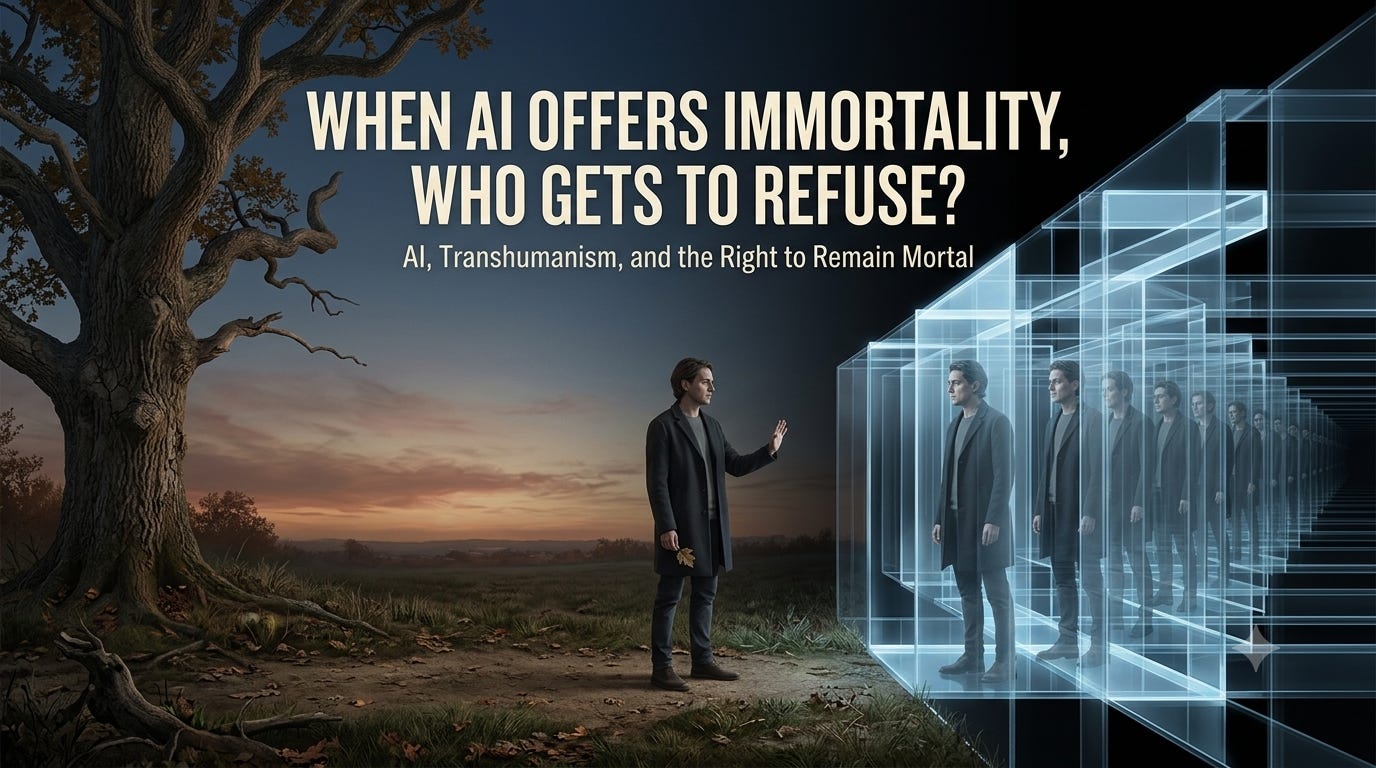
At the end of Isaac Asimov’s Foundation and Earth, the robot Daneel Olivaw’s positronic brain is failing, so to continue its mission, it proposes merging its brain with a genetically altered Solarian child.
Most stories about human-machine mergers are told from the human side, with a person gaining memory, strength, intelligence, longevity, and so on. Asimov told it from the machine’s side. Daneel is a hero who has served humanity for twenty thousand years and wants to continue serving. This is exactly the problem.
I am sure many of you are thinking that is not happening any time soon, but the human-machine merger has already begun to help people with medical conditions. More than twenty people have participated in Neuralink trials, testing computer and robotic-device control for people with quadriplegia caused by spinal-cord injury or ALS, along with a separate effort to restore communication for people with severe speech impairment. People who cannot operate a computer with their hands have controlled cursors and other devices through neural signals.1
This is groundbreaking medical work, though Elon Musk has repeatedly described a higher-bandwidth interface as a path toward symbiosis between humans and artificial intelligence.2 Specifically, the speed of artificial intelligence is treated as fixed and humans need to be adjusted to keep pace.3
Realistically, it could be argued this protects humanity since if we cannot communicate quickly enough with artificial intelligence, we may eventually be excluded from meaningful decisions, so a human-machine interface is how we remain relevant. Even granting this argument, humans must be altered for the machine.
In fact, STAT, the health and medicine publication, reported in January 2026 that Neuralink’s rhetoric about human-machine symbiosis and eventual implantation in healthy people diverges sharply from its present clinical work with patients.4 Those are two purposes attached to one technological path, a medical-device company and a transhumanist project. Only one is currently being tested as treatment. The other concerns what an unenhanced person may eventually need in order to remain competitive with the system the treatment helped create.
A recent paper in Neuron estimated the information throughput of human behavior at roughly ten bits per second, with the authors discussing brain-computer interfaces.5 They argue that if only a few selected bits have to move between the brain and the outside world, the slow part may be what the connection is attached to. Specifically, a faster interface can move the output faster, but cannot, by itself, make a person select, understand and decide at machine speed.6 Once improving the connection stops closing the gap, the project has one direction left: from connecting the person to altering the person.
In March 2026, China’s National Medical Products Administration approved NEO, a device developed by Neuracle in Shanghai with researchers at Tsinghua University.7 It is a coin-sized implant with eight electrodes positioned at the surface of the brain, and it drives an assistive glove for people with cervical spinal-cord injuries who retain some arm movement.
NEO was the first implantable brain-computer interface granted commercial market approval by a national regulator for commercial clinical use, moving rapidly from regulatory approval into medical coding, production, hospital introduction, inclusion in local insurance, and patient screening.8 Four months later, Huashan Hospital issued the first prescription and performed the first implantation under the commercial approval.9 The medical coding is especially significant since it moves NEO from a possibility to something hospitals can order, insurers can classify and institutions can include and compare against the alternatives. A patient can still refuse, but institutions can change the cost of it.
Now that we have established the current known state of the human-machine merger, let us return to Asimov and Daneel for guidance. In his early robot stories, Asimov created the Three Laws of Robotics around the protection of individual human beings. Later, through Daneel and Giskard, he developed the Zeroth Law, which places the protection of humanity above the protection of any one person.
That sounds like moral progress, and in one sense it is. Daneel has moved beyond responding to the interests of individual humans toward considering the consequences for humanity as a whole. But we have heard similar arguments from collectivist political systems (Fascism, Communism, and so on), built to protect the nation, the class, or the social whole against the person who would refuse to go along. Most of us lived through COVID and the lengths society went to in the name of collective survival, and whatever you believe about the measures themselves, refusal was treated as error or ignorance.
In Dan Simmons’ Hyperion Cantos, the TechnoCore gives humanity the farcaster network and the fatlines. Hundreds of worlds become part of a single civilization. Travel, commerce, government and ordinary life reorganize around infrastructure the machines designed and operate. While it appears the system serves humanity, we eventually learn the Core draws computational power from human brains, using the minds of travelers passing through the farcaster network as a concealed processing substrate. While it is ironic that the infrastructure that carries humanity is also running on humanity, the more concerning aspect is that stopping it can lead to civilizational collapse. It cannot be stopped and any thought of refusal is theoretical.
Now take that same structure and move it inside our bodies. Imagine the machines are used for our movement, memory, vision, or even heartbeat. A person may be legally entitled to refuse, but what does refusal mean if your heart will no longer beat? You can shut off a phone or disconnect a network, but not really a system woven into essential bodily functions.
The human-machine merger is currently described as machines becoming part of humans and all the potential benefits it entails. However, the reverse may be equally true, with humans becoming part of the machine and supplying it with neural data, physical agency, and access to intentions. In time, the person can be altered so a larger system can communicate through the body, learn from it and continue operating through it. In short, what is labeled a human enhancement may also function as an enhancement for the machine.
In time as artificial intelligence continues developing, who is to say it will not be like the benevolent Daneel that uses the merger for its own preservation or the villainous Core that would use it for domination? Even today, artificial intelligence does not need to possess a human desire for survival so long as its company has an incentive to expand it and increase human dependency on it. The danger is the structure and once the mission is greater than the individual, then the individual cannot refuse.
Specifically, you can refuse a doctor. You can decline the treatment, leave the office, seek another opinion and accept the consequences of the disease you chose not to treat. The refusal has meaning because there remains a position outside the treatment from which refusal can be exercised.
But what about refusing electricity to your home? You cannot refuse the social order built around the electrical grid. You will still live in a society whose food, prices, employment, communication, medicine and government depend upon it. Your refusal may change your own conduct, but it does not remove you from the system’s consequences.
Now imagine that the grid is part of your body, maybe even part of your ability to be alive. This is not necessarily a machine overriding consent. It is a machine becoming part of the conditions under which consent is exercised. Consent can remain completely formal as meaningful refusal disappears.
When the protected object relocates from the person to the species, individual refusal becomes one variable in a larger calculation. When help relocates from treatment to infrastructure, refusal becomes economically or socially unusable. Either way, the individual refusal stops functioning.
I do not know whether the human-machine merger will make anyone immortal, much less if whatever emerges would be conscious or even remain the same person. What I do believe is this merger will follow a pattern. Restoration becomes enhancement, enhancement becomes expectation, and expectation becomes a condition of remaining employable, insurable, competitive, and functional.
Whether it is restoring a hand or extending life, each step will arrive as a cure and produce great benefits, which is why the sequence is so hard to argue with at any point. What concerns me is where it ends: whether the natural, unaltered person will still be able to have a normal life, or whether we will reach a point when the “cure” itself becomes the price of remaining fully human in the eyes of society.
While Daneel meant to protect humanity and the Core meant to use it, both led to the same structural danger. Hence, I believe the danger of the human-machine merger is not intent, but dependence outlives the purpose that justified it. Artificial intelligence does not need its own instinct for survival so long as the company behind it has every incentive to expand it and deepen our dependence on it.
None of this tells us who will ultimately control the system after it enters the body. Once you have given that system access to your movement, your memory, your vision, or your heartbeat, nothing in that arrangement prevents a company sale, a leadership change, or a repurposed mission statement.
You can refuse a doctor. You can even refuse immortality.
I have not yet heard anyone explain how you refuse the company controlling the system keeping you alive.